

Student Name
Capella University
NURS-FPX6424 Data Mining to Advance Healthcare
Professor Name
Submission Date
Proposal to Administration: Spreadsheet and Video Presentation
Greetings, esteemed administrators. My name is _________. I’d like to extend my Welcome to you for this presentation. This will consist of a spreadsheet and video presentation. The presentation will be presented using the data and the recommendations to medication safety concerns in a 40 bed medical/surgical unit. Studies have shown that the use of medication is one of the most common sources and preventable causes of harm to hospitalized patients. Such errors should be identified and corrected to be a key element of the quality of care issue. Signs also exist that if medication tools are used properly and training on medication tools is given to nurses, the amount of medication errors will substantially reduce. I have tracked Medication Error Rate (MER) for the past 6 months in my unit and have used EHR/ CDS in my unit.
Analyzing What, Why, and How to Measure a Specific Quality Outcome
The aim is to monitor number of errors induced for giving medicines in the medical surgical unit to assess level of care provision. This measurement was selected as the one to measure because it is directly related to the outcomes of medication errors in patient safety. It has long been known to be one of the major causes of iatrogenic harm in the acute care hospital setting. We looked at the initial error rate of the three months’ data for January to March 26 and found that it was at 8.2 errors per 1,000 doses, above the Institute for Safe Medication Practices (ISMP) error rate. This indicates that our medication administration system was ineffective in preventing errors in medication administration.
We have since created an action plan to tackle problems with the error rate, with particular focus on carrying out more audits on the compliance of the nursing staff with the implementation of computerized clinical decision support systems (CDSSs). For each nursing staff member who has successfully completed medication reconciliation and each medication administration near miss; For nursing staff’s knowledge and skills in using electronic health records (EHRs). For example, during audited period, nurses frequently failed to check the CDSS alerts but did not do the medicine reconciliation at patient admission and at patient discharge, but rather gave the medicine to patients without first checking the CDSS alerts.
My benchmarks are based on: ISMP 5.0 or fewer errors per 1,000 doses, CDSS alert compliance (90% or higher), completion of medication reconciliation (90% or higher) as specified in The Joint Commission NPSG.03.06.01, and 4 or fewer near miss events per month. The competency, set forth by the technology informatics guiding education reform (TIGER) framework, for a nurse’s competency with EHRs is set at 85% or higher. Finally, you should not have more than 30% of the alerts override. Audit logs in the EHR; CDSS audit logs, medication list reconciliation workflow logs, incident reporting system data and competency assessments of personnel. Together, this will provide us with a good idea of how our unit is functioning and what could be impacting it and causing it to have a better or worse performance.
Evaluating Data Measures and Trends
Data collected from January to June indicate progress is good on the medicine safety front. The rate of medication errors in Jan. was 8.2 errors/1,000 doses. It reduced its errors to the national level by June, to 5.0 errors per 1,000 doses, a decrease of 39% in errors after 6 months! The percentage of compliance with CDSS alerts was higher than 90%, and higher in June when compared to January at 98% versus 54% respectively. There was an increase in the rate of medication reconciliation from 61% (in January) to 92% (in June). The incidents of near misses decreased from 12 incidents per month on average to 3 for nurses, and the competency of nurses using the EHR improved from 48 percent to 88 percent (a target of 85 percent for competency for nurse use of EHR). There was a significant drop in the rate of overriding alerts, from 38% to 14% – this is well below the expected 30%.
The higher the number of interventions, the better the metrics are. Improvements in metrics is correlated with implementation of interventions. Compared to nurses dropping the alerts, there was a significant increase in nurse EHR skills, nurse confidence and use of CDSS alerts to prevent medication errors. For each increase in CDSS adherence level the less errors were made, and the closer they were to the patient. Murthi said that the tools could be integrated into the workflow in the EHR, which would decrease fragmented care as well as decrease medication adverse events. This correlation, from month to month, is shown in Table 1.
Table 1
Healthcare Outcome Trends by Month
Month | Medication Error Rate (per 1,000 doses) | CDSS Alert Compliance (%) | Medication Reconciliation Completion (%) | Near-Miss Incidents | Nurse EHR Competency (%) |
January | 8.2 | 54 | 61 | 12 | 48 |
February | 7.9 | 58 | 65 | 10 | 54 |
March | 6.5 | 67 | 72 | 8 | 63 |
April | 5.8 | 74 | 79 | 7 | 71 |
May | 5.1 | 81 | 85 | 5 | 79 |
June | 5 | 98 | 92 | 3 | 88 |
There are 6 rows (one for each month) for the months of January-June, in the year 2026. There are six metrics that are being monitored – each column corresponds to a selected metric. The data indicates that there is an overall increase in compliance, competency, and reconciliation, along with an overall decrease in error rates and near-misses. Data visualisation, like a spreadsheet or bar graph, helps healthcare teams to spot patterns faster and more easily and helps them to inform unit-level (evidence-based) decisions (Park et al., 2021). A bar graph (Figure 1) is used to visually represent the above-mentioned alignment. On the bar graph comparison, from January to June, there is clearly a trend that both compliance and competency bars are rising, and the bars for error rates & near misses are decreasing. This will readily demonstrate that the Unit is going in the right direction.
Figure 1
Healthcare Outcome Trends by Month
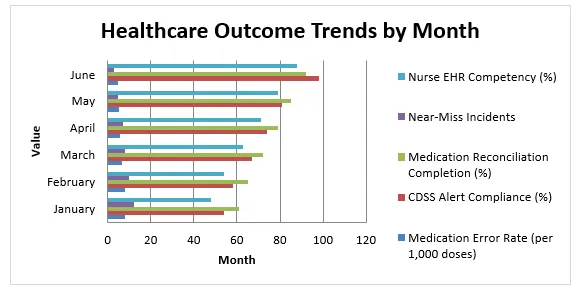
Note. Bar chart illustrating six-month trends across five medication safety metrics for a 40-bed medical-surgical unit.
Conclusions and Recommendations
After half a year, it has been clear that if nurses are supervised on the situation while teaching them to use clinical decision support systems (CDSS) and require them to consistently complete medication reconciliation, they will experience fewer medication errors. Administration should continue to have a re-education protocol for 48 hours every time there is an overnight override rate greater than 30% experienced by the nurse. Apply alerts for a combination of drugs that have been identified in the literature review and are deemed to be high risk. Make sure that the staff completes a medication reconciliation at each step in the workflow (whether formal or informal) within the electronic health record (EHR). Conduct a review of the skills of all nursing staff based on the TIGER Framework on a quarterly basis to ensure skills are kept to a high level. Develop a monthly safety dashboard for nurses and/or pharmacy providers so that emerging issues are proactively dealt with. To sum up – there has been considerable progress towards our overall objective! The national expectations for reporting of medication errors were met, and we had higher than planned usage of the CDSS system. Also, over the last 6 months, we have seen a significant drop in the number of ‘near-miss’ events. This information can be utilized to provide evidence-based practices on nursing and health technologies, which can contribute to providing better patient care. We will also build on this success by educating nurses, continuing to improve our use of electronic medical records (EMRs), and reviewing our monthly data to ensure that we continue to make the progress we have set and work towards improving our safety standards for our patients in our nursing unit. Thank you for your attention, I’d be glad to answer any questions you may have.
References
Altmiller, G., & Pepe, L. H. (2022). Influence of technology in supporting quality and safety in nursing education. Nursing Clinics of North America, 57(4), 551–562. https://doi.org/10.1016/j.cnur.2022.06.005
Kluwer, W. (2022, September 23). Understanding national patient safety goals for hospitals. Www.wolterskluwer.com; Wolters Kluwer. https://www.wolterskluwer.com/en/expert-insights/national-patient-safety-goals-for-hospitals
Murthi, S., Martini, N., Falconer, N., & Scahill, S. (2024). Evaluating EHR-integrated digital technologies for medication-related outcomes and health equity in hospitalised adults: A scoping review. Journal of Medical Systems, 48(1), 1–19. https://doi.org/10.1007/s10916-024-02097-5
Park, S., Bekemeier, B., Flaxman, A., & Schultz, M. (2021). Impact of data visualization on decision-making and its implications for public health practice: a systematic literature review. Informatics for Health and Social Care, 47(2), 175–193. https://doi.org/10.1080/17538157.2021.1982949
Shermock, S. B., Shermock, K. M., & Schepel, L. L. (2023). Closed-Loop medication management with an electronic health record system in U.S. and Finnish hospitals. International Journal of Environmental Research and Public Health, 20(17), 1–14. https://doi.org/10.3390/ijerph20176680